
Interior harmony
The Teal Room: How One Colour Can Anchor an Entire Home
One deliberate colour decision, applied with restraint, does more for a home's harmony than a full repaint ever will.
Why Anchor Colours Work
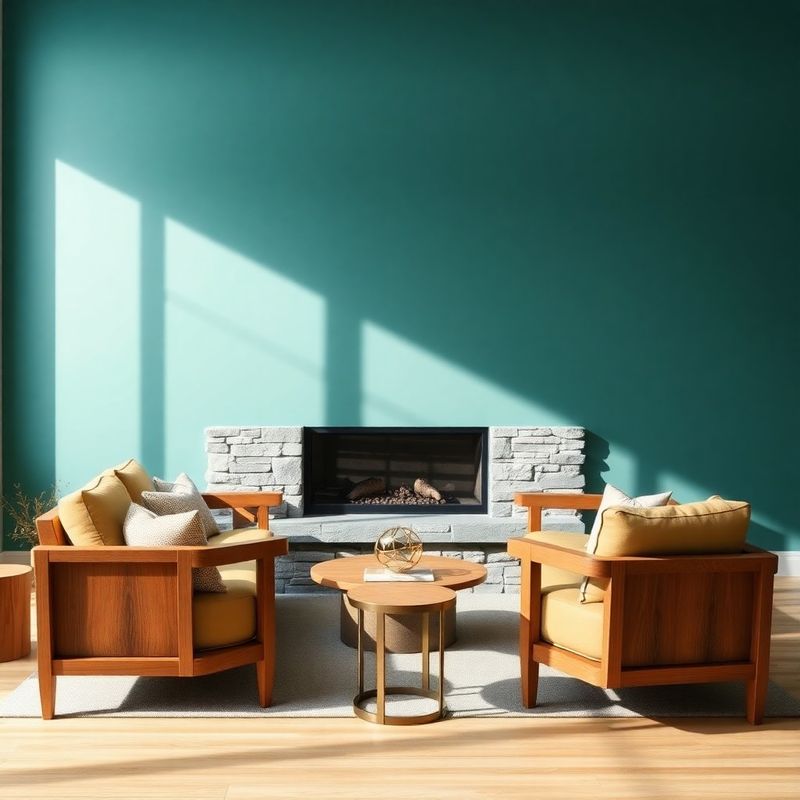
There is a reason some rooms feel immediately resolved and others feel like they are still waiting for something. More often than not, the missing element is an anchor colour — a single dominant hue that the eye returns to and that tells the rest of the room where to stand. Teal occupies an unusually useful position in the colour spectrum for this purpose. It sits at the intersection of calm blue and living green, which means it reads differently depending on the light around it: cooler in the blue-grey mornings that define a Winnipeg winter, warmer and more botanical when summer sun hits the wall at three in the afternoon. That spectral flexibility makes it one of the most forgiving choices an interior can absorb. Applied to a single feature wall, it does not overpower. Applied to a large wardrobe or a kitchen island, it grounds the furniture without competing with the surrounding tones. Applied to a front door visible from the living room, it creates a visual line that organises the whole open-plan space. The modern teal palette — specifically, the mid-depth, slightly desaturated versions that sit closer to a calm ocean than a bright peacock — pairs naturally with warm timber, brushed brass, raw linen, and the kind of off-white that contains just enough yellow to feel like actual light rather than a paint chip.
How to Use It Without Overdoing It
The most common mistake with a strong colour like teal is application anxiety — either using too little (a single cushion does not qualify as an anchor) or overcorrecting into saturation (four teal walls in a small room will fight back). The rule Terrawstone applies is the 60-30-10 principle with a twist: if teal is your accent, it earns its place as the ten percent, but that ten percent must be structural — a wall, a piece of furniture, a built-in shelf — not decorative scatter. In a bedroom, this might mean a teal bedhead against white walls, warm timber nightstands, and linen bedding in oat or stone. In a home office, a teal-painted alcove that frames a desk turns a practical corner into a place that feels considered. In a bathroom, teal tiles limited to the shower recess create depth without closing the room in. The key in each case is repetition through material rather than colour: once you have set the teal anchor, echo it not with more teal but with other elements that share its weight — dark hardware, matte surfaces, plants with deep-green leaves. The result is a room where the teal registers as a decision, not an accident.